
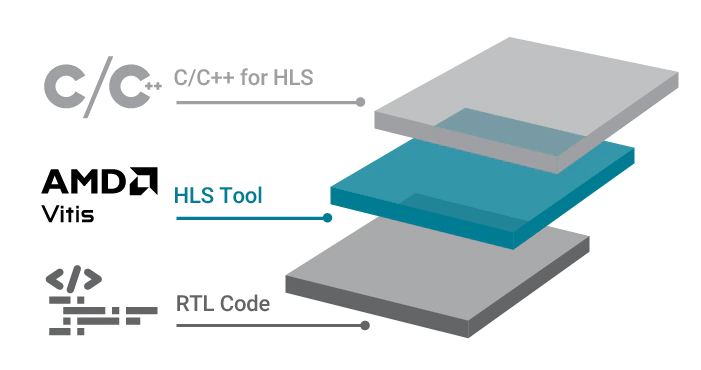
This FIR filter FPGA Vitis HLS implementation generates an optimized DSP IP core for real-time signal processing.
Finite Impulse Response (FIR) filters are among the most widely used components in digital signal processing (DSP). They are essential in applications such as wireless communications, audio processing, radar systems, and FPGA-based real-time filtering.
In this tutorial, we demonstrate how to implement a low-pass FIR filter on FPGA using AMD Vitis High-Level Synthesis (Vitis HLS) and deploy it as an optimized IP core.
Project Overview: FIR Filter Design Using Vitis HLS
The goal of this project is to:
- Design an FIR filter in MATLAB
- Implement the filter in C++
- Synthesize the design into RTL using Vitis HLS
- Export an FPGA-ready IP core
- Verify performance through simulation and FFT analysis
This workflow is widely used in FPGA-based DSP development.
Step 1: FIR Filter Design in MATLAB
We began by designing the FIR filter using MATLAB FDATool with the following specifications:
- Filter Type: Low-pass FIR filter
- Cutoff Frequency: ~2 MHz
- Stop-band Attenuation: ~68 dB
- Coefficient Format: 16-bit signed integers
The coefficients were exported from MATLAB for use in the hardware implementation.
Step 2: FIR Filter Reference Model in C++
Next, we developed a C++ reference model to validate the filter behavior and generate golden simulation results.
The software model served as:
- A functional baseline
- A reference output for RTL co-simulation
- A verification tool during HLS development
Step 3: Vitis HLS Workflow for FPGA Implementation
The complete Vitis HLS design flow included:
- C Simulation
- High-Level Synthesis (RTL generation)
- RTL Co-Simulation
- IP Export for FPGA integration
Vitis HLS successfully converted the FIR algorithm into a synthesizable IP core.
Step 4: Performance Optimization Techniques in Vitis HLS
In this FIR filter FPGA Vitis HLS design, loop pipelining and coefficient symmetry were applied to improve throughput.
Symmetric Coefficient Optimization
Since FIR filters often have symmetric coefficients, we leveraged symmetry to reduce the number of multiplications, cutting logic resource usage almost in half.
Array Partitioning
We applied the array_partition directive to enable parallel access to coefficient and delay-line arrays.
function Pipelining
Pipeline directives were added to the top function to maximize throughput.
As a result, the design achieved:
- One output sample per clock cycle
Step 5: Testbench Input Signal and FFT Analysis
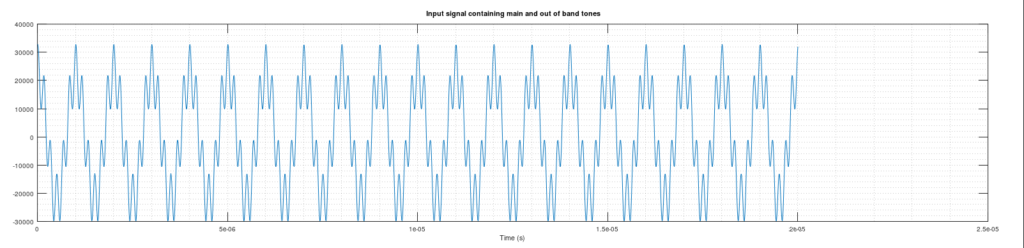
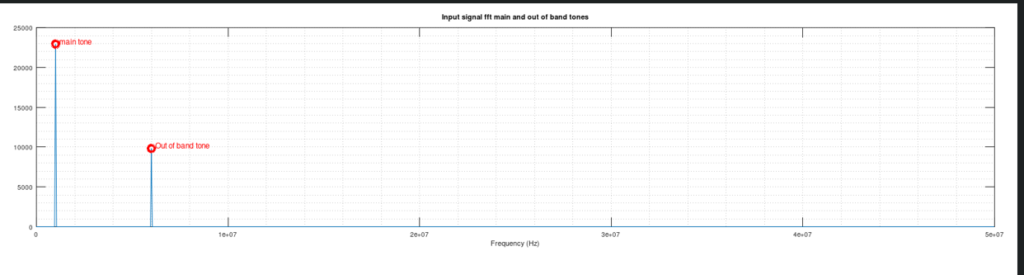
To validate the FIR filter, the input signal consisted of:
- A 1 MHz sinewave in the passband
- A 6 MHz sinewave acting as high-frequency noise
Input Signal
FFT of Input Signal
Step 6: FPGA Simulation Results Using XSim
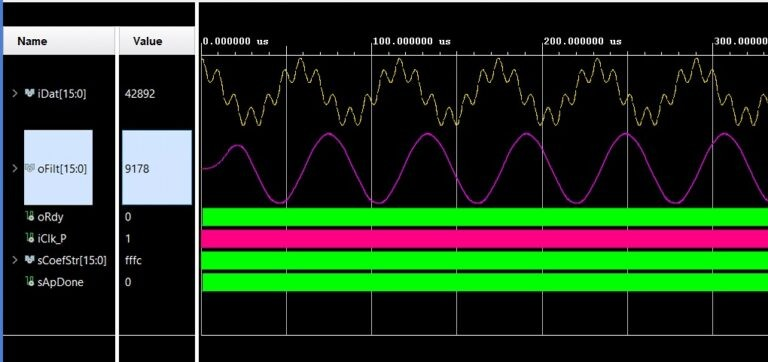
After exporting the FIR IP core, we integrated it into a Vitis FPGA project and simulated it using XSim.
Time-Domain Output
The simulation waveform confirmed that the noise component was significantly reduced.
Frequency-Domain Output
The FFT of the output showed strong attenuation of the unwanted 6 MHz signal.

By measuring the FFT bin difference, we achieved:
- ~68 dB stop-band attenuation, matching the MATLAB design target.
Step 7: Simplifying and Optimizing the IP Interface
In addition to datapath optimizations, improving the IP interface structure is an important step toward building a more professional and reusable FPGA core.
In this stage, we applied optimizations to both the coefficient interface and the signal input/output ports.
Reducing Excessive Array Ports
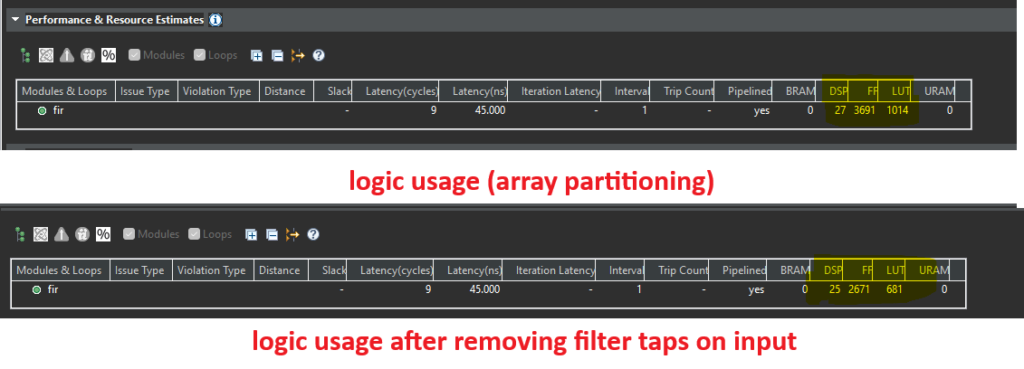
When using array_partition, Vitis HLS may generate a separate 16-bit input port for every FIR tap. In our case, this resulted in 54 individual coefficient ports, which significantly increased interface complexity.
Since the FIR coefficients are constant, a better approach is to define them as global compile-time constants rather than passing them as input arguments. This eliminates unnecessary ports and slightly reduces overall logic utilization.
Using Modern AXI-Stream Interfaces
In many FPGA-based DSP systems, AXI-Stream interfaces are preferred because they simplify integration with the rest of the design pipeline.
To improve compatibility and system-level usability, we modified the function arguments so that Vitis HLS could automatically infer AXI-Stream input and output interfaces. This makes the generated IP core easier to connect to other processing blocks in a complete FPGA signal chain.
Frequently Asked Questions (FAQ)
What is an FIR filter in digital signal processing?
An FIR (Finite Impulse Response) filter is a digital filter commonly used in DSP because it is stable, provides linear-phase response, and is well suited for FPGA implementation.
Why use Vitis HLS for FIR filter implementation?
Vitis HLS allows designers to implement FIR filters using C/C++ instead of writing RTL manually, enabling faster development and optimized FPGA IP generation.
What optimizations improve FIR filter performance in HLS?
Common techniques include loop pipelining, array partitioning, coefficient symmetry, and resource sharing to achieve high throughput.
How do you verify FIR filter FPGA output?
Verification is typically done through C simulation, RTL co-simulation, XSim waveform analysis, and FFT-based frequency-domain validation.
Conclusion: FIR Filter IP Core Generation with Vitis HLS
This FIR filter FPGA Vitis HLS workflow demonstrates how DSP algorithms can be deployed efficiently as FPGA IP cores.
With proper optimization, we achieved:
- One sample per clock throughput
- Efficient FPGA resource usage
- Accurate stop-band attenuation performance
Source Code on GitHub
The full project source code is available here:
👉 FIR Filter Vitis HLS Project Repository
FIR filter repo
For more FPGA projects, visit my Blog Homepage.